
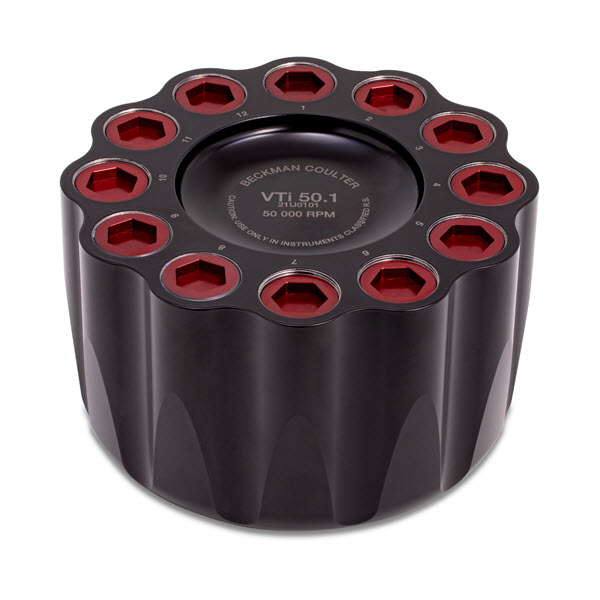
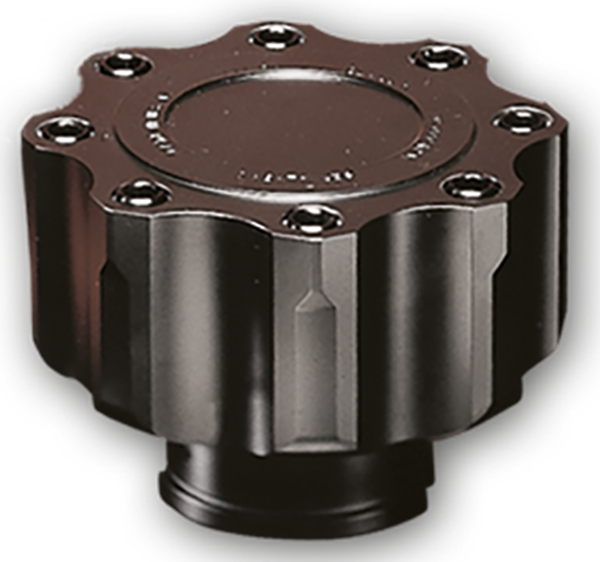
Rotor à angle vertical
Les rotors à angle vertical présentent la longueur de trajet la plus courte, le temps d'exécution le plus rapide et la plus haute résolution.
Dans un rotor vertical, les tubes sont verticaux pendant la course. La courte longueur de trajet et les faibles facteurs K de ces rotors signifient que la particule n'a qu'une courte distance pour se déplacer vers une pastille, ce qui réduit le temps d'exécution de l'application.
Ce n'est pas le meilleur rotor à utiliser pour la granulation, car la force centripète dans un tube parfaitement vertical écarte la pastille sur toute la paroi extérieure du tube.
Un rotor vertical est utilisé pour
:
- Séparations isopyciques - spécifiquement pour la bande de DNS dans le chlorure de césium
- Séparations de coussins en gradient et densité, comme pour les particules virales
Dans un rotor vertical, les tubes sont verticaux pendant la course. La courte longueur de trajet et les faibles facteurs K de ces rotors signifient que la particule n'a qu'une courte distance pour se déplacer vers une pastille, ce qui réduit le temps d'exécution de l'application.
Ce n'est pas le meilleur rotor à utiliser pour la granulation, car la force centripète dans un tube parfaitement vertical écarte la pastille sur toute la paroi extérieure du tube.


FAQ on Vertical Angle Rotors
What applications are vertical rotors commonly used for?
Vertical rotors are commonly used for isopycnic centrifugation, density gradient separations, plasmid DNA purification, viral particle isolation, lipoprotein analysis and other ultracentrifugation workflows that require rapid equilibrium separations.
What is a vertical rotor?
A vertical rotor is an ultracentrifuge rotor that maintains sample tubes parallel to the axis of rotation during centrifugation. This geometry creates the shortest sedimentation path of any rotor design and helps accelerate density gradient separations.
Why are vertical rotors used for isopycnic centrifugation?
Vertical rotors provide a very short path length through the density gradient. This allows particles to migrate quickly to their equilibrium density, helping reduce run times while maintaining high separation resolution.
What is the k-factor of a centrifuge rotor?
The k-factor is a measure of a rotor's sedimentation efficiency. Lower k-factor values generally indicate faster particle sedimentation and shorter run times. When comparing ultracentrifuge rotors, the k-factor can help determine which rotor may provide the most efficient separation for a specific application.
Are vertical rotors suitable for pelleting applications?
Vertical rotors are generally not the preferred choice for pelleting. Because the tubes remain vertical during centrifugation, pellets may spread along the outer wall of the tube rather than forming a compact pellet at the bottom. Fixed-angle or swinging-bucket rotors are typically better suited for pelleting workflows.
What is the difference between a vertical rotor and a fixed-angle rotor?
Vertical rotors are primarily designed for density gradient and isopycnic separations, where particles move through a gradient to reach their equilibrium density. Fixed-angle rotors are typically optimized for pelleting applications, where particles sediment toward the tube wall and form a pellet. The choice depends on whether the goal is particle pelleting or high-resolution gradient separation.
When should I use a near vertical rotor instead of a vertical rotor?
Use a near vertical rotor instead of a vertical rotor if particles in your solution will pellet out of solution and risk contaminating your gradient bands. In a near vertical rotor, those containments will move to the bottom of the tube instead of remain on the side wall, as they do in a vertical rotor.
